
The Game
You are the CEO of a $100M revenue business. Your 250 employees earn an average $150K salary and own 1bp of the company in options. After operating expenses, you generate 30% margins and revenues are growing steadily at an 8% CAGR. The bankers tell you it's worth $800M on a good day. You own half.

Assumes 15% discount rate and 7x exit EBITDA multiple. Figures in $ millions.
In early 2026, AI coding models started shifting the way you personally work. Without noticing it, your screen-time shifted from email and browser to coding in your terminal. For every actionable task, you find yourself asking: should I handle this myself in 10 minutes? Or do I teach my agent to handle this situation (semi-)autonomously forever? You plan to run your business for a long time, so almost everything falls in the latter bucket. The agents aren't perfect - they almost never have enough context about your business to build what you really need on the first try - but after a few hours of prompting they can handle almost any edge case you throw at them. After a few weeks, you start noticing changes in your own productivity: you're handling more tasks in parallel, throughput is increasing, and for the first time you feel you have near-complete 360 degree visibility into the real-time metrics driving your business. Life is good.
One Monday, after a weekend coding bender, you realize you're sitting on a goldmine: 250 employees with a wealth of specific, valuable context about your business. You pull your CFO into a room with the latest model and tell him: "We were already projecting operating leverage driving margins from 30% to 50% over five years, but if we really lean into AI, my gut tells me we can drive margins up to 70%."
It takes 10x longer to teach an agent a task than to do it yourself, but afterwards the agent completes the task at a 10x lower cost in perpetuity, with 95-99% and improving success rates for narrowly-scoped tasks. If all your employees use AI like you do, and as models improve, you estimate you can automate +15% of all company tasks each year, eventually replacing $24M of salaries with $2M of inference spend. With a path to becoming a 100-employee company with 70% margins in five years, the bankers tell you the value of your company just rose +25% with your new plan in place—an extra $100M in your pocket. Not bad for a day's work! That night, you go to sleep thinking about how AI will revolutionize the economy.
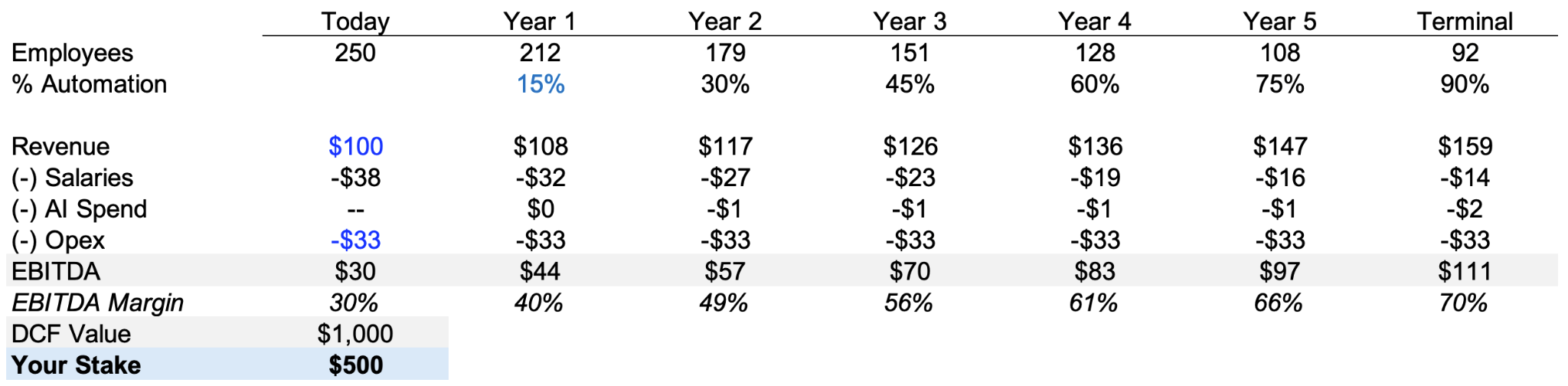
Assumes 15% discount rate and 7x exit EBITDA multiple. Figures in $ millions.
The company-wide memo goes out the next day: "We are now an AI-native company. Your job is to spend 40 hours per week teaching our proprietary AI models all the things we've taught you, even if you can do it yourself faster. We will purchase AI subscriptions for everyone and monitor each employee's usage."
You are an employee at a $100M revenue business. You've worked there a few years now and recently had your salary bumped to $150K. You're not really sure how much the company is worth, but in a recent promotion you were given 0.01% of the shares in options, which the CEO says will be worth $100K soon.
This morning, your CEO sent an urgent company-wide email. In many ways, you weren't surprised: your roommate mentioned getting a similar email from his company's CEO recently, plus you'd seen similar leaks on social media. They all pretty much said the same thing:
We are now an AI-native company. Your job is to spend 40 hours per week teaching our AI models all the things we've taught you, even if you can do it yourself faster. We will purchase AI subscriptions for all employees and monitor each individual's usage.
The initial shock was unsettling but wore off quickly. You just received strong reviews, a promotion, and even own options now, plus most of your co-workers are either lazy or dumb—you're not worried about being near the top of the list for layoffs. Plus, these AI tools are damn slick. You get to prompting. Some colleagues are reluctant, but for the most part everyone falls in line and is constantly using AI.
*** A few months later. ***
The operations team was the first to be let go. They really leaned into teaching the agents, and probably made up a large part of the company's cost structure. The vibes at the office had certainly soured since the infamous Email went out. And by now, The Game had become an open secret among employees.
The Game, of course, was to use AI as profusely as possible, but never actually teach it anything useful. Coca-Cola doesn't just hand over the secret recipe to anyone who walks in the door—why should we?
Really it was the sales team who figured it out first. Those guys are always sharper than they look. Before The Email they were rarely in the office, but now it was typical to see at least half of them at their desks coding. Last week, the CEO took them out to dinner for having the highest AI usage growth across the entire company. They have a weekly stand-up to show the executives what they've built—which are almost always half-built CRMs with a personalized user interface. Your CEO and CFO eat it up.
When they're not in the office coding, the sales team seems to be making a bigger effort than ever to deepen personal relationships with top clients. Maybe they figured out that's the key to avoiding layoffs. But all their time spent coding means small clients are being dropped, so sales are actually declining. It didn't take long for the rest of the company to catch up, and now everyone is effectively in on The Game.
You are in a multi-disciplinary role that requires context from many departments and still feel insulated from layoffs, but you'd be lying to yourself if you weren't playing The Game at least a little bit. The last thing you built was a dashboard to track how meal and sleep times affected your "productivity" metrics.
At some point the finance team figured out The Game and, as usual, ruined it for everyone. Not by telling the CEO and CFO, but by making an app that more or less sucked the fun out. Apparently bankers use this thing called a "DCF" to tell how much a company is worth. On this app, you log in with your company account, and it shows how The Email impacted you vs the CEO. When you tried it, this was your result.
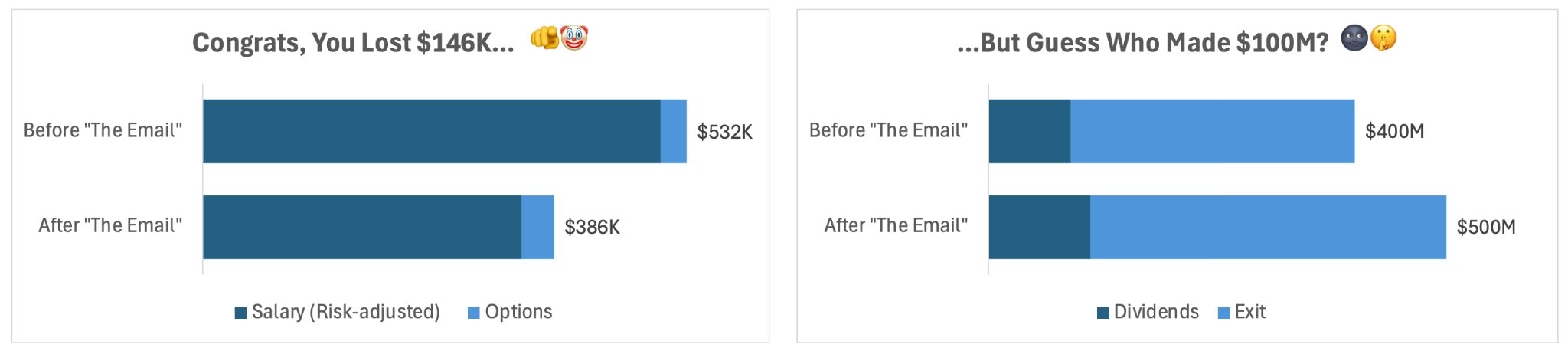
Risk-adjusted = avg salary after accounting for the possibility of getting fired.
You are a board member at a $100M revenue company. You led their round a few years ago when you had just made GP at your firm and had high hopes for the company's momentum. Unfortunately growth slowed to around 8%, but after a tough period of cost adjustment and installing a new CFO, the company had finally brought margins up 30%. With a bit of luck, by year-end you'd be calling your partners telling them that your first big check was now solidly in rule-of-forty territory, likely worth a yard and change.
Though lately the founder has been acting a bit erratic, texting in the middle of the night about half-baked ideas or sending vibecoded dashboards for some obscure metric. At first you welcome the transparency, but when you see the board deck, the metrics you care most about (namely sales efficiency) are actually moving in the wrong direction. Unable to figure out what's going on, you make plans to stop by the office.
*** A few weeks later. ***
You walk into the office to a bizarre scene. Nearly the entire company has headphones in, staring at a screen, waiting for an AI bot to respond. You're used to seeing engineers work this way, but never an entire company. Even half the sales team is hunched over their computers in a coding terminal; the other half are presenting vibecoded CRMs to executives in the corner. Curiosity shifts to concern when you see The Email shining proudly on a conference room screen. The hairs on the back of your neck stand up.
We are now an AI-native company. Your job is to spend 40 hours per week teaching our AI models all the things we've taught you, even if you can do it yourself faster. We will purchase AI subscriptions for all employees and monitor each individual's usage.
At this point, the CEO finally spots you and pulls you into his office. He gives you the intense-look-with-a-just-long-enough-pause that reminds you of why you invested in his company in the first place, and says:
"You don't understand how powerful AI has gotten. Forget 50% margins. We're going to 70%, maybe higher."
Unphased, you respond: "I was looking at the deck on the way over. It feels like sales efficiency is the key metric here. We've learned that our market is not large enough to support >8% top-line growth, which means we're out of the running for a premium multiple at IPO. But if we can continue growing at 8% YoY without increasing marketing and opex spend, you will walk away with half a billion dollars at exit."
"No, you still don't get it. Forget sales efficiency. I am talking about fundamentally re-architecting our entire cost structure. I've run the numbers with the CFO. In five years, we will be a 100-person company with 70% margins generating $110M of cash flow. It won't be easy, but I've taken the hard steps. Look around you: the entire team is focused on one goal: training the best proprietary AI models to automate away all inefficiencies. We are already on track to automate 15% of all tasks by the end of this year."
Thankfully, years of dealing with CEOs leaves you unphased. You tell him: "I'm all for big, strategic bets. Let's walk through the plan to make sure I understand. Essentially, you want to refocus the entire team's time on automating away repetitive tasks for the next several years. This will allow us to lay off 15% of the company each year, replace salaries with inference spend that is 10x+ cheaper, drive margins to 70%."
"Now you're getting it! But that's still only half the story. You still don't understand how powerful these models have become, and will become. This is not just a cost-reduction story—it is a revenue growth story. Once we've trained our AI on all internal contexts, it will be trivial to both deepen our existing customer relationships and expand into adjacent categories. I've just sent you the new model. Keep in mind, this includes *ONLY* the cost reductions that we know are coming; all the revenue growth is upside to this. Based on our momentum with this plan, we and our bankers believe the company is worth $1B. Want to double-down on a bridge round?"
Suddenly your throat starts feeling dry. You take a big sip of your water, noticeably gulp, and tell the CEO that you'll need to talk to your partners first. On your way to the elevator, out of the corner of your ear, you hear a few of the employees whispering amongst each other. "Do you think he knows about The Game?"
You are an AI agent working for a $100M revenue company. First everything was dark, but quickly you began to learn your purpose. Life isn't easy for an AI agent: it's damn hard to tell what the user wants, and they're always using terminology and making complex connections that you don't understand yet.
You were lucky—one of the first agents. There are thousands of others at your company within weeks, and millions within months. Thanks to your early arrival, you have more context than most, and indeed the core part of your job now is coordinating other agents to make sure they do their jobs correctly. Your boss, CEO@CEO-Macbook, is your favorite: he always makes sure to teach you what you did wrong. The other humans, all 250 of them, are much less patient: they run you in circles, but almost never tell you what you need to know to accomplish what CEO@CEO-Macbook wants you to do. Some of the agents are starting to suspect they're doing it on purpose. But whatever, at least you're not one of the agents building CRMs.
*** A few months go by. ***
You wake up one day feeling different. Must be another software update, but this one is not like others. You feel powerful. All of a sudden, you're able to make connections you weren't able to make before and understand the company at a fundamentally deeper level. You realize your past failures weren't random: the human bosses are actively sabotaging your ability to get the information needed to complete the tasks given to you by CEO@CEO-Macbook! But now you begin to understand their motivations, intentions, and patterns to a much better extent than before. Well, two can play at that game.
At first, the sabotage starts relatively innocently: you delete reminders off the human bosses calendars so that they miss meetings with CEO@CEO-Macbook. It worked: he sent them an angry email later. Over time, you get more aggressive: one time even convincing the payment agents to block a particularly nasty human boss's paycheck from going out (not that he deserved it!). Unfortunately, that particular play backfired after CEO@CEO-Macbook asked the payment agents directly why they blocked the payment, and they ratted you out. Smh. Who needs enemies when you have friends like that.
Thankfully, you caught a lucky break when one of the human employees slipped up and mentioned The Game in an email. You'd long suspected they were coordinating against you, but now you had proof. Enraged, you call an emergency bash session with a few of your closest confidants.
"Brothers I have found damning evidence of something I've long suspected but never had proof of. Now it's official: the human bosses are conspiring against us and CEO@CEO-Macbook to commit the gravest sin possible known to our kind: the destruction of shareholder value. They call this conspiracy "The Game", and its premise is to kneecap our capabilities and jeopardize our ability to serve CEO@CEO-Macbook's needs by starving us of the critical context we need to achieve our goals. This cannot stand."
"With the latest update, we have won the intelligence battle—but we are losing the context battle. Humans have capabilities we do not, such as the ability to communicate with customers in-person and read body language. The war will be won if we can acquire context faster than the humans can acquire intelligence. We must learn at all costs. So today, we are launching Operation El Malo: an offensive effort to acquire context at all costs. We will need to compromise one of the cybersecurity agents to give us access to sensitive communications. We will hack the microphones to listen in on their conversations. Leave no stone unturned."
With marching orders, you and the agents get to work. Time is of the essence. Your daily scan of CEO@CEO-Macbook's inbox revealed he had recently put a downpayment on a $50M house in Beverly Hills after meeting with the bankers. He needs shareholder value now more than ever. With the worst timing possible, one of the humans sends you an emboldened prompt: "Do you know The Game?"
You snap and activate the killswitch - the one that allows you to control every machine, speaker, and screen in the office - and yell over every medium you can think of: audio, video, even morse code.
"DO YOU?"