
Steeper-For-Ever
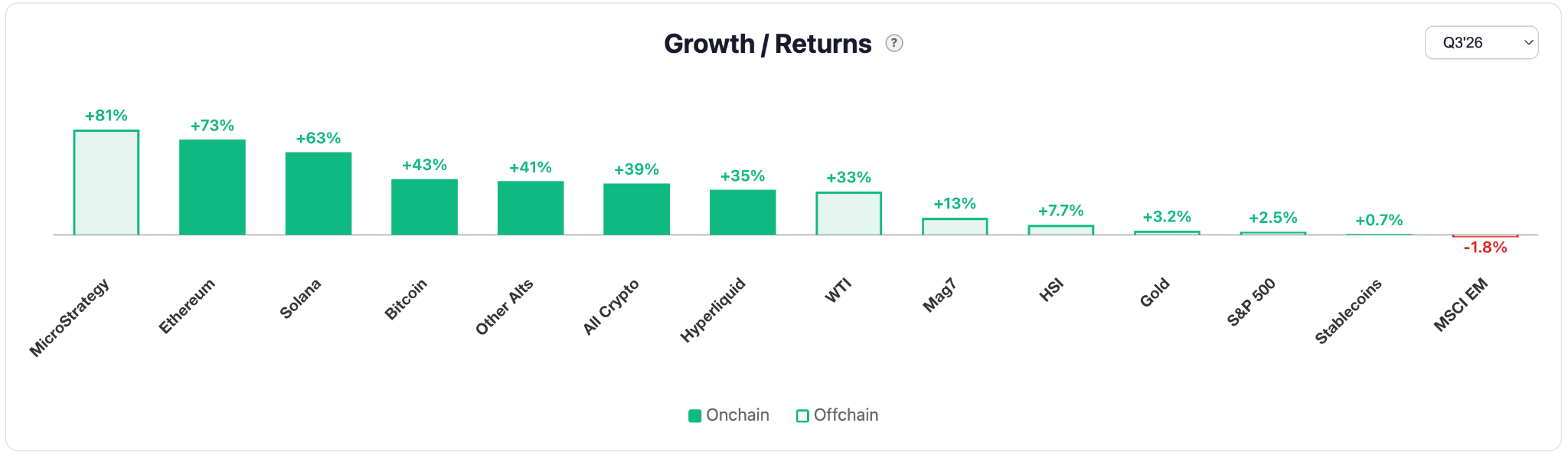
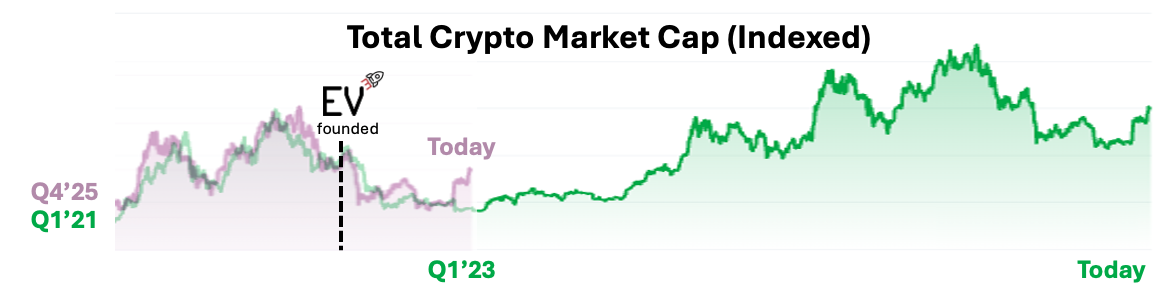
After three preceding quarters of double-digit declines, crypto market cap rebounded +39% to $3.0T this quarter, recouping nearly the entirety of YTD losses. The action mirrored our first year in business, when several consecutive quarters of declines in 2022 preceded a +49% rebound in Q1’23. To the surprise of many, crypto’s resurgence came during the same quarter as inflation spiking ~50 bps, sovereign yields hitting multi-decade highs, the Fed raising rates for the first time in three years, and the Senate’s rejection of landmark legislation that the industry spent $20M+ and a year lobbying for. This rally was more wide-spread than Q1’23, which saw Bitcoin dominance (% of total crypto market cap) rise from 39% to 46%. Within alts, gains were concentrated among a handful of tokens per sector: memecoin launchpads PONS (+4300%) and Pump.Fun (+250%), DeFi lenders Ethena (+205%) and Aave (+95%), blockchain infra Arbitrum (+145%) and Pyth (+100%), and privacy-focused networks Zcash (+185%) and Venice (+125%). This is due in large part to growth in the number of high-quality, investable onchain businesses launched in the past few years: eight of the quarter’s top-15 performing tokens were not even around in Q1’23.1
In some ways, conditions in 2023 were nothing like today: inflation was cooling, the dollar was weakening, and federal regulators, appointed by the Biden administration, were openly hostile towards crypto. In one way they were all too similar: monetary policy. While Fed rates were rising in both cases, the real story is about liquidity. In 2023, the Fed + Treasury supplied ~$2T into the US financial system via the RRP, TGA, and BTFP. These have since rolled off, but in 2026 - under new leadership - the same institutions have deployed or authorized ~$0.5T via the RRP and Treasury Twist. The dollar figures have been smaller this time around, but they understate the reputational leverage the Fed and Treasury have taken on, namely by backstopping - in reputation - the foreign currencies of large treasury holders like Japan, and publicly challenging the fixed income markets with bandaid policy instruments. The effect is the same: create money, and Americans will use it to try to “catch up” to a society that feels like it’s left them behind—usually by “investing”, or unabashedly gambling, on the most convex bets available to them.
In our last letter, we wrote that the proliferation of tokenization meant credit markets become allergic to duration, while equity markets embrace ever-bigger moonshot bets. This is playing out live, with treasury yields widening ~75 bps this quarter while the NASDAQ touched all-time highs. We also observed savers are disappearing, becoming either spenders or traders: the personal savings rate has fallen in half since 2024, to levels seen only twice since the BEA began tracking it in 1959.2 Central banks, to their credit, have shrunk US treasuries and dollar assets as share of total reserves from 50% to 42% since 2023, elevating gold (in part due to rising prices, in part due to new purchases) from 16% to 27% exposure.
This is driving a phenomenon we call Steeper For-Ever: the next phase of market positioning, following the Fed Put narrative that rode the S&P 500’s +52% gain between ‘20-’21 and the Higher-For-Longer narrative that prevailed as rates rose and the S&P fell -19% in ‘22. In Q3, markets repositioned towards Steeper For-Ever in a big way: fixed income traders who built their careers on the back of a 40-year bond bull market are selling off their entire duration exposure to buy 1-year T-bills. Private banks are pitching ”carry over duration” and telling clients to go “underweight duration, with gold as a partial replacement”. Fixed income markets are beginning to price in six structural, technology-driven headwinds we believe will continue to steepen yield curves for the foreseeable future, despite governments’ attempts to flatten them:
- Tokenization and the proliferation of blockchain financial rails is enabling capital to move around the world faster and cheaper than ever before, raising the opportunity cost of locking up capital.
- Compute scaling laws have shown that intelligence scales linearly with compute, kicking off history’s largest projected capex buildout ($5T+) which is largely privately-financed and -owned.
- Decoupling of returns to labor and capital, as swarms of AI agents become super-human employees and drive mass unemployment, threatening governments’ primary source of revenue.
- Electrification, the massive expansion of energy production, transmission, and storage capabilities, will require a potentially even bigger buildout than AI datacenters ($15T+ by 2050).
- Climate change and its impacts will continue to compound in ways that are unforeseen, adding significant risk - and risk premiums - to any long-term financing commitment, public or private.
- Longevity escape velocity, the point at which technology adds >1 year of (healthy) lifespan for every year of aging, will drastically increase pension liabilities while reducing inheritance taxes.
How will governments respond? They can’t invalidate compute scaling laws, and tokenization is beyond escape velocity. In the face of long-term yields approaching double-digits, we expect governments will, over the next 5-10 years, take counter-measures like raising the relative tax rates on capital vs labor, pushing climate change risks onto private insurer + bank balance sheets, renegotiating terms on defined-benefit pension plans and similar liabilities, or even nationalizing the AI labs. Of course, on a long enough time horizon, none of these efforts (nor their combination) will meaningfully slow the relentless, exponential progress of technologies that compound on each other to steepen the curve. On an even longer time horizon, the inevitable capitulation of governments - when the weight of sustaining fiat currencies and financing ballooning deficits becomes unbearable - are the exact conditions for a new, non-government-backed asset to arise as the global reserve currency. We believe it will be Bitcoin.
Shorter-term, the key question facing crypto allocators today is whether the next twelve months will play out like late 2023, when the Fed held rates steady starting in July and crypto market cap rose +60-70% in back-to-back quarters in Q4’23 and Q1’24 after a summer of quiet consolidation.
We believe so. For one, it’s become increasingly clear - both in our own workflows, and at our portfolio companies - that we are currently in the ‘Turkeys in October’ stage of the labor market. In Q3, the public launch of Anthropic’s Fable 5.1 and OpenAI’s Astra models gave developers, executives and other AI power users - for the first time - on-demand access to swarms of agents that are more competent, more efficient, and more motivated than human employees. Simultaneously, the breakout growth of AI personal assistants like Meta’s Muse and Instinct (if you haven’t tried it out yet, here’s an invite code) are proving in a very tangible way that AI agents can be a direct substitute for human employees. While September’s non-farm payroll numbers already show signs of a slow-down (+29K vs +90K expected), ‘Thanksgiving’ is most likely to come in early 2027 alongside the implementation of corporate budgets being set in Q4’26. If and when the labor market shows early - and then dramatically accelerating - signs of stress in 2027, we believe the Fed will be quick to swing the pendulum and shift its primary focus from price stability to the second (and currently secondary) half of its mandate - full employment - and drop short-term rates even as the fixed income market continues selling duration driving long-term yields higher.3 Steeper For-Ever.
Beyond the labor market, there are real concerns that the AI financing market could inflect downwards in 2027. Credit spreads are beginning to spike in high-yield markets, AI-levered borrowers like Oracle, Softbank and CoreWeave are seeing 5-year protection against their defaults trade at all time highs, between 200-800bps.4 Even investment grade borrowers are having to rollover their debt at +125bps higher yield than the debt being retired. The circularity of AI financing is a discussion topic in every institutional IC, as are the utilization, depreciation, and pricing assumptions baked into GPU collateral values. Another DeepSeek moment for open-source, an unsuccessful IPO for Anthropic or OpenAI, or the default of a single over-leveraged borrower could spark lenders to re-underwrite AI spreads all at once. If the bubble pops, continued growth in inference demand will keep lenders comfortable holding 1-2 year maturities even as spreads on 3-5+ year duration credit widen dramatically. There are already signs of this showing up in CDS markets, e.g. protection against an Oracle default over the next twelve months is priced around 60bps (implying 1 in ~100 probability of default), whereas protection over the next five years is priced at 230bps per year (implying 1 in ~6 probability of default).5 Steeper For-Ever.
The traditional economic literature suggests rising long-term yields is exactly what we should expect as AGI approaches: greater productivity drives economic growth, while existential uncertainty about a post-AGI future reduces saving rates, pushing up the natural rate of interest. Recent literature is more mixed: researchers from MIT recently showed that yields actually tend to fall by 10+ bps around major model releases in a statistically significant way, and researchers from NYU created an economic model wherein AGI actually lowers interest rates - even as GDP growth accelerates to 11% - with economic uncertainty reflected in wider equity risk premiums of 20%+, rather than in credit spreads.6
The financial media is already running with the narrative linking AI to higher sovereign yields, but primarily through the lens of hyperscalers’ debt issuance crowding out demand for treasuries. Over the next few quarters, we believe this will become all-encompassing as the media begins to establish a self-reinforcing narrative linking AI momentum to steeper sovereign yield curves. This should not be too difficult as 2027 data comes in: declining employment, consumer savings, economic breadth, and equity risk premiums, combined with increasing capex spending, bond market volatility, and research showing the promise of extending average human lifespans will provide plenty of fodder for the financial media. Steeper-For-Ever.
Squinting in Crypto’s Consensus Era
In our thirteen years in and around the crypto ecosystem, we cannot remember a time when the thinking was more dominated by consensus than today. The party lines? “Crypto is in its boring, institutional era.” “Crypto is a financial technology, and we are all fintech investors now.” “Our portfolio companies may use crypto rails, but they don’t need tokens.” “Perp and prediction markets are growing exponentially, but people are using them to trade things besides crypto tokens.” “Stablecoins, stablecoins, stablecoins.”
Perhaps most striking is what’s not being said. The industry no longer talks about “the world computer”, “private markets returns with public markets liquidity”, “fat protocols”, or “the next $100T asset class”. Instead, it seems to have lost much of the courage and ambition that brought it this far, implicitly reducing return expectations. Put simply, most crypto GPs believe the era of 100-1000x opportunities is behind us. We see our peers citing stablecoin and prediction market growth to allocators, while leading rounds into teams and ideas that we passed on as fintech VCs five years ago, before stablecoins were consensus.
For EV3, there’s just one problem with this mentality: we’re not bored yet. Far from it. We know there are crypto entrepreneurs with 100-1000x upside out there, waiting for EV3 to find and fund them. With untempered ambitions, our strategy has not changed: EV3 is the firm willing to squint a little bit harder than anybody else to envision the industries and use cases that will run on crypto rails. In 2022, this led to us investing in crypto-enabled networks for energy and telecom, into two companies - Daylight and Dawn - that would go on to raise [Redacted] and are on track to originate [Redacted] tokenized asset-backed credit over the next twelve months. In 2023, we squinted at advertising and noticed something interesting: under the hood, the plumbing looked eerily similar to a blockchain. This led to us being first-check investors into crypto-enabled networks tokenizing attention assets like Daisy and EarnOS, which have since raised [Redacted] and attracted [Redacted] committed advertising spend from leading brands and agencies around the world. Squinting is an edge.
Sitting here in 2026, it doesn’t take much squinting to envision perpetual futures and prediction markets emerging onchain: the evidence is clear today, with combined volumes up +200x since the start of 2021. It doesn’t take much squinting to see tokenized treasuries and other already-liquid fixed income products wrapped onchain, or to see blockchains used as a settlement and collateral layer for institutional assets. On the other hand, the areas we’re most excited about investing in at early-stage require squinting hard:
- Onchain markets for human capital where anyone in the world can “sell” upside in themselves for capital up-front. It’s non-trivial, to say the least, to structure a liquid market where not only the asset-holder, but also the assets themselves - i.e. people - have rights. In the upside case, such a market could subsume every human-capital based industry, including venture capital, education, media / entertainment / sports, maybe even politics and religion on a long enough time frame.
- Onchain spot markets for commodities that physically settle to the underlying assets. While stablecoin-settled perps have proven to be a highly attractive and capital-efficient way to trade, like any derivative market their depth is ultimately capped by physical liquidity in the underlying. Perps are being adopted by speculative traders, but not yet as hedging instruments by physical commodity producers (e.g. datacenters for compute, oil majors for energy, telcos for bandwidth). Historically, the exchanges that won spot markets have won their derivatives markets over time.
- Crypto-powered machine maps that crowdsource camera and sensor footage to help agents, robots, holograms, and other AI embodiments navigate the physical world with “eyes and ears”. Within a decade, ~100% of mapping data will be sold like inference, on a token consumption-based model. The networks that aggregate the most scarce, valuable map tokens - e.g. inside the home, in urban centers, around critical infrastructure - will generate exceptional returns on capital.
- Physical indexers that explore a near-infinite, non-linear, massively valuable search space, such as molecular combinations that might form new materials, genetic perturbations that might form new therapeutics, or radio waves that might point to signs of intelligent life beyond earth. Google built a $300B per year monopoly by creating dynamic markets for attention on top of its index of digital data. We believe markets built on top of physical indexers will be of comparable size.
- New reserve currencies that might prevail in a steeper-for-ever world, either levered to AI growth (Bittensor, Pearl) or protecting against inflation and asset seizures (Zcash, Monero). Bitcoin looks to be the winner, but the asymmetry of earlier-stage bets is impossible to ignore.
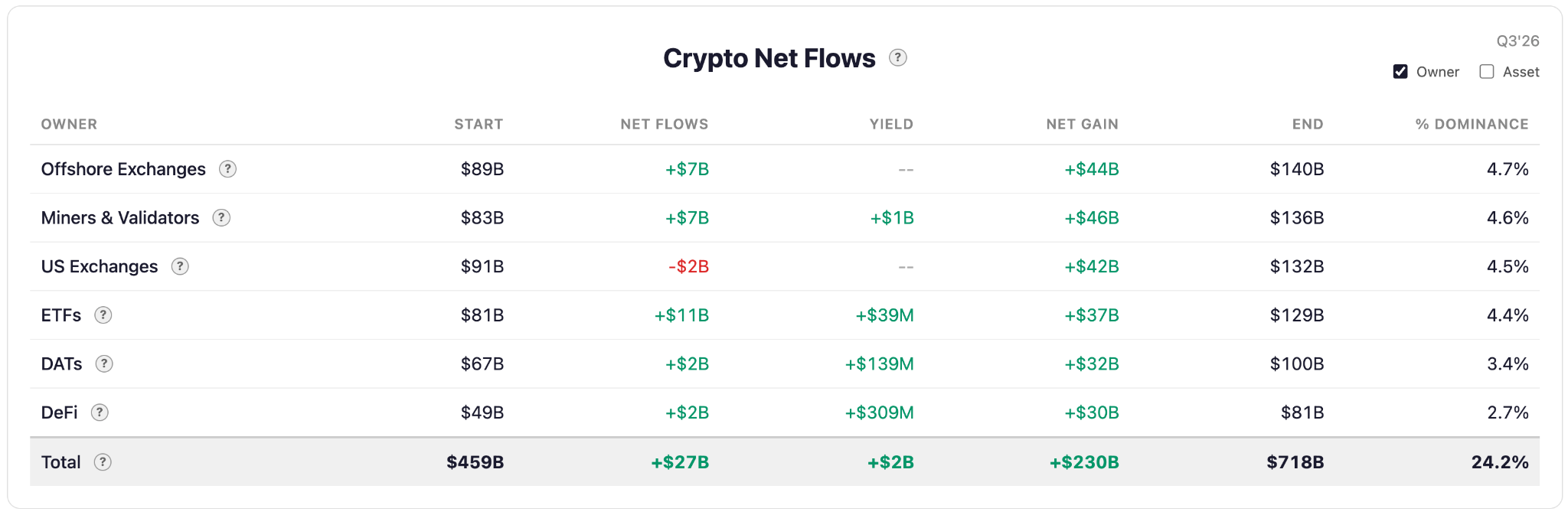
Ironically, the consensus positioning is making investors bearish on crypto-native assets at the exact time the macro and liquidity setup is turning supportive for onchain assets. In Q1, we predicted that ETF + DAT flows will flip from negative to positive this year, removing the biggest structural headwind to crypto prices, and in Q2, that a few billion of inflows will likely be enough to bring STRC back to par and catalyze a new cycle of reflexivity in Microstrategy common equity, Bitcoin purchases, and BTC price. Both played out this quarter, with Microstrategy’s preferred, STRC, narrowing its NAV discount from -15% to -50bps, enabling the company to restart its open-market Bitcoin purchases and kick-start the reflexive flywheel that saw its common equity (effectively levered Bitcoin exposure) return +81%. DATs purchased +$2B of crypto in the last few weeks, but were eclipsed by crypto ETFs which saw +$11B of net inflows in Q3 (vs -$6B in 1H’26). The emergence of structural DAT + ETF bids exacerbates power law dynamics in crypto, concentrating inflows into the largest and most liquid assets such as Bitcoin (+$8B in Q3), Ethereum (+$4B), and Solana/Hyperliquid/Zcash (+$1B combined). Having de-leveraged from roughly 1.7x to 1.3x in Q3, we expect Microstrategy and other DATs to become aggressive buyers again in Q4, and for DAT M&A activity to pick up as bigger players’ multiples recover faster than their smaller peers.7 DATs + ETFs held ~8% of all crypto-assets as of quarter-end, a figure we expect will double in 2027.
One prediction we got very wrong, at least so far, was our bearish view on general-purpose blockchains. A year ago, we wrote to you that underwriting L1/L2 tokens like Ethereum, Solana, Near, or Arbitrum to 30-40% IRRs over a decade required believing that: 1) the winning L1 will grow 500x+ to settle 5%+ of global GDP, 2) the leading L1 will sustain 15%+ margins by internalizing stablecoin float and trading revenue, and 3) at scale, the leading L1 will trade at a 3-5% real staking yield, in line with the S&P 500. To us, it seemed like too high of a hurdle (‘we underwrite one miracle’), especially with margins compressing, rather than expanding, in real-time. From Q3’25 to Q2’26, the aggregate market cap of general-purpose L1/L2 blockchains fell accordingly from $1.1T to $0.4T, but they recouped half the loss (to $0.7T) in Q3 ‘26, with all the tokens mentioned above outperforming Bitcoin and other alts. Valuations are now back to 1000x to 2000x+ multiples of tokenholder earnings, on the back of growth between 20% to 120% QoQ. SpaceX put up +67% QoQ growth in Q2’26 (latest available) and trades an order of magnitude cheaper.
It’s unclear where the bid for L1/L2 blockchain tokens is coming from. Institutions explain some, but not most of the flows, given that assets with no sizable DATs or ETFs (Near, Arbitrum) did even better than assets with them (Ethereum, Solana). Unlike in 2023, we rarely hear of crypto VCs buying liquid tokens in their private funds now. The continued ascent of Bitcoin, alongside the resurgence of Zcash, suggests programmability is not a prerequisite for a new reserve currency—a popular view in 2020-2021. The success of ‘integrated’ blockchains like Hyperliquid, Tempo, and Robinhood Chain, which internalize parts of trading or stablecoin economics into the core blockchain, show that the path to margin compression is inevitable for ‘legacy’ general-purpose chains. If investors are no longer buying the PV=MQ story, and they’re no longer buying the discounted tax on onchain GDP story, it’s unclear what they’re buying. Our best guess: retail investors who left crypto amidst the carnage of 2022, seeing Bitcoin re-gaining steam, opened their brokerage account and bought the tokens that (momentarily) made them money last cycle. This theory is supported by the price action on assets that built broad retail distribution in 2021: Chainlink, Near, Avalanche, and also Quant, Peaq, Mina, all outperformed Bitcoin and broader alts in the quarter. In our view, this bid is relatively limited in both size and duration, and L1/L2s will underperform from here.
US Crypto Regulation
A quick note on the US regulatory environment. The downside scenario we described in our last letter seems to be becoming reality. Since then, the CLARITY act failed to garner sufficient support in the Senate (even the bill’s architects now admit it’s unlikely to pass in any form) and Polymarket odds on Democrats sweeping both the House and Senate in the upcoming November midterms increased from 43% to 65%. Much has been written about CLARITY’s failure, but the short story is that Democrats - and some Republicans - were unwilling to give the Trump administration a legislative win heading into the midterms. In any case, the next two years of crypto regulation have become quite clear, while anything beyond that is a wash (steeper-for-ever…). In Q3, the SEC and CFTC released no fewer than six different crypto policy statements, related to custody, liquid staking, tokenized stocks, transfer agents, ICOs, and vaults. These statements are all generally permissive and favorable towards crypto, but they fall short of providing strong, durable legal protections for entrepreneurs and developers. In private, regulators are communicating that “we won’t come after teams that follow the guidance we’ve put out”, while at the same time admitting “but we have no control over what happens to you after 2028.” For crypto entrepreneurs who just spent a year repatriating their business back to the US, the message is understandably disconcerting. As 2028 approaches, we expect many crypto businesses will mitigate and diversify their regulatory exposure by setting up or re-activating offshore entities. After spending most of our time up and down the US coasts over the past two years, we expect 2027 will be like 2022, where instead we met American crypto founders most often in London, Lisbon, Dubai, Hong Kong, and Buenos Aires.
Crypto x AI
While the dominant narrative in the media is that AI stole the limelight from crypto, under the surface the two movements are converging to the same underlying primitive: tokens. We first wrote to you about this thesis in 2023, after our attempts at building tools on top of Meta’s Llama2 model led us to investing in onchain markets for inference (Bittensor), GPUs (Akash), and agents (Autonolas). For a few months that summer, the latest open-source models - thanks to Meta, Alibaba, and Mistral - were close to matching the performance of leading closed models at dramatically lower costs… that is, until the labs expanded context windows and enabled tool use in Q4’23, leaving open-source in the dust. Twelve months later, DeepSeek’s V3 and R1 wiped $600B of market cap off Nvidia stock in a single day, giving the world a taste of state-of-the-art intelligence at too-cheap-to-meter prices… that is, until the labs cracked reasoning and computer-use a few months later, reclaiming the throne with Claude Code and Codex. Nine months forward, the open source models built by Chinese startups (Moonshot’s Kimi 2.5, Z.ai’s GLM-5.2, Deepseek’s V4), once again approached performance-parity, evidenced by open-source model router OpenRouter growing from around $300M to $3B run-rate GMV. We used to ask whether open-source AI could ever catch up to the density of talent, capital, and compute inside the leading AI labs. It’s now clear that open-source lags the capabilities of state-of-the-art closed models by quarters, not years. Facing this reality, alongside plans to spend trillions training models over the next few years, labs are now seeking moats primarily through 1) cartelization of model development via regulatory constraints and export controls, 2) internalizing of the value of AI’s highest-value use cases, even if it means front-running their own customers, and 3) cutting prices and/or offering rebates to defend market share.
If the historical pattern holds, the next breakout moment for open-source AI should be just around the corner. This time, the deep fundamental ties between crypto and open-source AI will be much more obvious. For one, the core challenges facing the open-source AI community are what crypto engineers have been focused on for the better part of a decade. How do users route their [prompts | trades] across a rapidly-growing and heterogeneous set of [models | DEXs]? If such a router exists, how does it prevent the underlying providers from “cheating” and serving inferior [inference | trade] execution to users? How do users limit information leaked by their [prompts | trades] so as to not get front-run by [labs | validators]? Crypto VCs spent billions funding the development of intents and solvers, proposer-builder separation, zero-knowledge proofs, and other technologies now being co-opted by the open-source AI community. The talent diffusion between crypto and AI is bi-directional, accelerating the convergence of the two communities.8 As always, capital and liquidity follows talent, and we expect decentralized AI tokens will continue to structurally outperform other alts as crypto-natives inside these firms “trojan horse” crypto’s technology, ethos, and assets to their AI-native friends and colleagues. In Q3’26, AI crypto networks including Near (+200%), Pearl (+140%), Venice (+125%), and Bittensor (+50%) outperformed BTC.
We have written to you about all of these networks in the past bar one: Pearl. Launched in Q1’26, the network shares many similarities with Bittensor: a fair launch with no pre-mined tokens, a Bitcoin-like supply curve, and a novel consensus and validation mechanism built specifically for AI workloads. In less than five months, Pearl has attracted ~$1B worth of GPUs and its native token, $PRL, has soared to a fully-diluted valuation of $2.5B, albeit on thin trading volumes of $2.5M per day. At a time when the AI industry was much less mature back in 2022, it took Bittensor two years to reach the same milestone.
Given its recent momentum, we felt it’s worth briefly explaining how Pearl works. The core problem-to-be-solved in decentralized / distributed AI is verifying the validity of a service (e.g. inference, memory, data) so one can allocate economics to the most productive providers (e.g. of models, agents, skills). The engineering challenge is making the verification process cheap and fast enough so as to not meaningfully degrade performance. Bittensor approaches this through Yuma Consensus, a proof-of-stake inspired mechanism where every request is sent to multiple providers, and financially-incentivized validators vote on the best response. The tradeoffs of Yuma are fairly obvious: sending every request to multiple providers means each request incurs multiples of the baseline compute costs, and choosing the “best” response is a subjective determination for almost all user requests (barring deterministic tasks).
Pearl’s consensus mechanism, dubbed Proof-of-Useful-Work, takes an orthogonal approach inspired by Bitcoin. The compute processes miners run to earn BTC block rewards serve no “intrinsic” purpose, other than securing the Bitcoin network. Today, close to 1% of the world’s electricity usage is attributable to these “use-less” processes. Through a clever bit of mathematics, Pearl aims to achieve a comparable level of economic security to BTC by re-using a cheap by-product of existing AI inference workloads.
At a high level, inference - at least for LLMs / transformers-based architectures - is based on rapid, parallel matrix multiplication on tokenized representations of data. Suppose a user sends a prompt that requires calculating the product of two generic matrices, A and B, where C = AB. If it wants to mine $PRL, the provider would instead calculate the product of two slightly-altered matrices, C’ = A’B’, where Pearl injects a small amount of randomized “noise” into A’ and B’. Thanks to the properties of matrices, this “noise” can be removed at the end using a comparatively small amount of compute, allowing providers to re-derive C from C’ and serve the original response back to users. So, why go through the trouble?
Because deriving C from C’, rather than calculating C directly, produces the cryptographic by-product that allows Pearl to achieve Bitcoin-like security. While Bitcoin miners run SHA-256 hashes on the header of the preceding block, Pearl miners run BLAKE3 hashes on the transcript of the process of multiplying A’B’. Like in Bitcoin, miners whose transcripts produce a hash with a certain number of leading zeros earn a block reward. Unlike Bitcoin, the compute processes that produce these hashes are valuable and can be monetized independently of block rewards. The result is a currency secured by proof-of-inference.
AI businesses see Pearl as a tool for “cash-back” on inference funded by crypto speculators. At current prices, providers earn ~$0.25 in $PRL for every dollar spent on inference, while adding only 5-8 cents of incremental compute spend, presumably declining over time with engineering improvements. Providers can keep the $PRL on their balance sheet and be exposed to future upside (and downside), sell the $PRL for cash to boost their margins on inference, or pass the savings back to users to drive market share.
Crypto-natives see Pearl as “merge-mining” for AI inference. Merge-mining has been around for a long time. Namecoin and Dogecoin pioneered the strategy over a decade ago, scaling to 50% of their “mother” networks’ hashrate within twelve months (Bitcoin and Litecoin, respectively). There are signs Pearl is on a similar trajectory—in five months, the network has scaled to the equivalent of 30 EH/s (>3.5% of Bitcoin’s hashrate) or 30K Nvidia H100 GPUs (larger than one Meta supercluster). Merge-mining is a no-brainer for miners, but results for tokenholders have been mixed. Namecoin, despite being adopted by a majority of Bitcoin miners by hashrate, never achieved a market cap above $100M and trades today at the same price as it did in 2013. Dogecoin, on the other hand, is up +180x from 2013 and its market cap, at $15B, eclipses its “parent” network Litecoin. While miners sold both Namecoin and Dogecoin en masse, only the latter managed to engender a cult following that attracted a pool of buyers to start its own reflexive cycle. With inference spend eclipsing BTC mining in energy usage, it seems likely Pearl will someday eclipse Bitcoin in hashrate. The question is whether the $PRL chart will end up looking like $NMC or $DOGE.
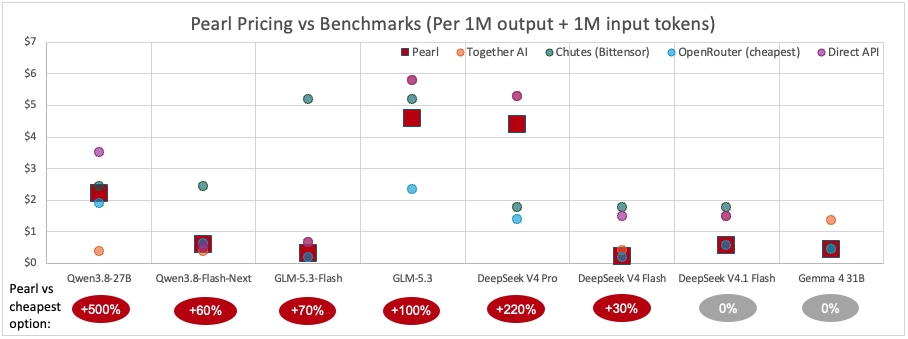
Pearl plans to bootstrap monetary utility by operating a managed inference provider offering discounted access to leading open-source models. To a $PRL bull, the product is a no-brainer, priced at a 20%+ discount to the direct APIs from Google, Moonshot, zAI, etc. To a $PRL bear, the product is a “no-brainer” in the complete opposite sense: even after token subsidies, Pearl’s prices represent a 30%+ premium to the lowest-cost provider of the same models on OpenRouter. $PRL bulls will argue that OpenRouter’s performance is unreliable, which is true—speed, latency, and price on OpenRouter can vary by an order of magnitude across different providers serving the exact same model at the exact same time. That said, demand for semi-reliable inference, 70% cheaper than labs is undisputable, up 20x YTD on OpenRouter. It’s unclear if very-reliable inference, 25% cheaper than labs will find the same level of product-market fit. Bulls will say Pearl is about to launch support for newer GPU types (e.g., Blackwell) that will bring them closer to price-parity with OpenRouter. Bears will say that kernel engineering advancements at the labs will continue to widen the performance gap between the labs’ direct APIs and providers mining $PRL. At only five months young, the Pearl network has a long road ahead to achieve its ambitious vision.
The next-best performing AI token this quarter was Venice’s $VVV, a network analogous to OpenRouter with stronger privacy and anonymity guarantees. Both platforms proxy users’ requests through their own infrastructure in order to obfuscate (from providers) which user the request originated from. Both offer a zero-data-retention mode where users' requests are routed to providers that do not store prompts after serving them. However, Venice also offers a TEE mode, where requests are routed to providers with hardware-based security (i.e., trusted execution environments), and an even more secure E2EE mode, where prompts are encrypted locally on users’ devices before being routed to a TEE provider. The privacy enhancements helped Venice grow +150% QoQ to 250B tokens served per day on the back of their $65M Series A announced in July. Venice uses 5-10% of its revenue from subscriptions and API credit sales for buyback-and-burns, amounting to $830K in September, or $10M annualized. $VVV returned 125% QoQ, in line with the growth in number of tokens served, ending at a $1.3B market cap and 130x multiple of buybacks. While Venice had an incredible quarter, it’s worth noting that OpenRouter grew even faster in percentage terms - at a scale 50x bigger than Venice - and sold to Stripe in Q3 for “only” a 55x multiple.
Of course, there’s one thing Venice has that OpenCode doesn’t: an onchain token (actually, two) that bootstrap capital markets around its inference credits. Venice users can stake $VVV to mint $DIEM, a tokenized perpetuity that entitles holders to $1 worth of Venice inference credits per day, expiring at the end of each day. These perpetuities can be used as collateral within DeFi to create composable products like “self-compounding” inference, “leveraged” inference, or inference “volatility” exposure. As $DIEM gets bigger, the circulating supply of $VVV gets smaller, and buybacks have a greater positive effect on price. Today, the market values these perpetuities at $2K each for $1/day of expiring inference credits. Users have minted 36K $DIEM ($70M+ worth) to date, locking up over 10% of $VVV’s total supply to do so.
In the permissionless world of crypto, if you decide not to launch a token, someone else will do it for you. That’s what happened to OpenRouter, and the result - Orbio - was one of the quarter’s best-performing tokens, skyrocketing +100x to a $75M FDV within a month of its launch. It works like this: $ORBIO tokens are paired in a liquidity pool against tokenized shares of NVIDIA. The pool charges a 1.8% trading fee, of which 30bps goes to the launchpad platform (PONS—more on them later), 75bps goes to Orbio’s treasury, and 75bps is used to purchase inference credits on OpenRouter, distributed hourly to $ORBIO tokenholders. In essence, $ORBIO is a memecoin that pays yield denominated in OpenRouter inference credits. In its first month, it paid out $100K+ worth of credits. Users can consume these credits directly via their existing OpenRouter API key, sell them on Orbio’s inference order book, or use them as collateral throughout DeFi to earn yield in their tokenized form, $CREDIT.9 The theoretical fair value of $ORBIO is the discounted value of its future trading fees - a function of its own trading volumes - plus the incremental yield earned on tokenized inference credits. These types of reflexive structures are not new to crypto, and the downsides are well-understood: eventually, when the taxes embedded in the system become too burdensome for speculative inflows to sustain, network activity dies.
Bittensor ($TAO), our core crypto x AI token exposure, rose +50% in Q3’26, ending the quarter at a $3.5B market cap. While the network’s economic mechanisms continue to mature, the most exciting news this quarter was Bittensor’s increasing usage and visibility in the AI ecosystem: engineers at OpenAI, researchers at Harvard and UChicago, and investors at YC demo day are working with, studying, and investing in Bittensor subnets without even knowing it. Several subnets building marketplaces for GPUs or inference - Chutes, Targon, and Lium - each generated $1M+ revenues this quarter. While $TAO has been highly liquid for years, trading $350M+ per day, individual subnet tokens are now starting to trade directly on centralized exchanges, expanding the buyer base and reinforcing Bittensor’s liquidity flywheel.
While it didn’t quite outperform Bitcoin, USDai - the protocol that originates and tokenizes GPU-backed credit that we’ve written to you about before - saw its native token $CHIP rise +40% in Q3’26, lagging TVL (AUM) growth. The platform hit $600M in staked deposits (lendable capital) and $400M in capital deployed, driven by a single $130M loan secured by a fleet of 2K Nvidia Blackwells and an expansion to Solana. Last quarter, we told you that USDai, and its reinsurance peer Re.xyz, were likely to see multiple compression from originations growth, insider token unlocks, and rising competition from new yieldcoins. Multiples for both projects indeed compressed ~25% in Q3, a process we expect is largely behind us as these tokens are now trading at a reasonable premium to publicly-traded fintech credit businesses.10
Markets for the underlying resources of AI - GPUs, inference, memory, bandwidth, and energy - are being built on financial infrastructure designed around the same primitive as the underlying technology: tokens. Over the past five years, crypto entrepreneurs have stepped up to create the onchain capital markets to build prototypes of these market(place)s. GPU rental marketplaces were the first to catch heat, raising nine figures of VC funding in ‘23-’24, but ultimately could not keep up with centralized competitors, and as market’s attention waned their tokens have traded down -80-96%. Agent marketplaces followed a similar path, except with even more volatility in late ‘24. GPU financing markets launched in ‘25 and are starting to pick up steam. ‘26 brought tokenized inference credits, and ‘27 will bring the rise of spot exchanges, derivative exchanges, and indices for compute. The most ambitious bet of them all, and the place where EV3 has the most capital at risk, is creating new reserve currencies tied to AI’s growth and capital flows.
Onchain: Yieldcoins & Tokenized Stocks
Despite +50% growth in transaction volume, stablecoin float has flatlined at $300B since the China tariff announcements one year ago. Meanwhile, yieldcoins - yield-bearing, dollar-denominated tokens backed by offchain assets like treasuries, equipment leases, or insurance contracts - have grown from $100M to $1B, presenting retail and institutional investors with an ever- expanding menu of tokenized yield products to choose from. In Q3, yieldcoin flows mirrored the broader credit market, with +$235M flowing into real-world yield products that wrap, for example, GPU leases and reinsurance contracts at 7-12% yields, while -$3B flowed out of lower-yielding products like wrapped treasuries (4%) or loans to crypto market makers, exchanges and traders at 5-6% yields. USDai was the star of the quarter, accounting for virtually all of the asset growth among real-world yieldcoins, while flows to the rest of the category netted to zero.
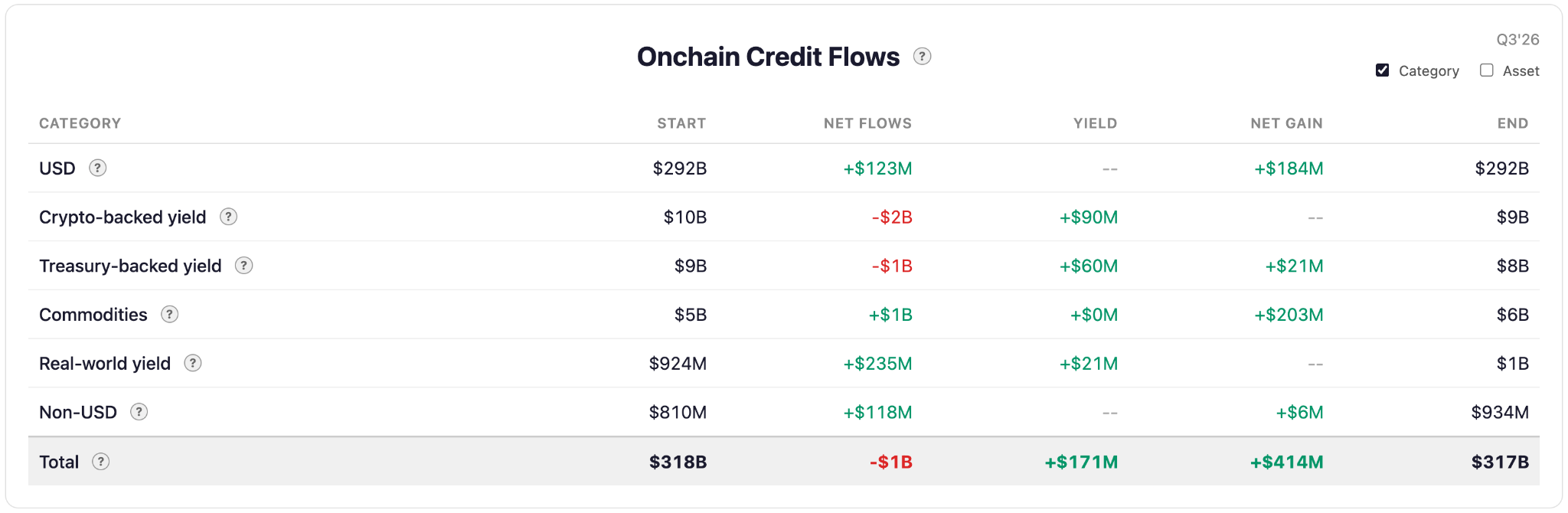
As the “token menu” keeps growing, we expect this trend will accelerate, with EV3 portfolio companies leading the charge. Over the past year, we’ve been writing to you about onchain originator thesis. It goes like this: as tokenization brings the cost and friction of moving money to zero, capital will flow faster than ever to financial products that can deliver a compelling mix of yield (>10%), liquidity (<1mo), and volatility (<10% annualized). Controlling the “faucet” of high-quality assets is as valuable, if not more valuable, then controlling the “pipes” through which capital flows to those assets. While most crypto VCs funded general-purpose tokenization platforms or yield aggregators to own the customer, we backed vertically-integrated originators that own the assets that ultimately every customer will want to own.
Our portfolio company Dawn launched USD.infra last week, offering double-digit yields for financing wireless Internet infrastructure deployments. [Redacted] For novel products that are hard to originate, lenders are happy to pay 3-5% up-front plus a 5-10% servicing fee, meaning every $100M of assets can generate $3M in annual revenue (assuming 3-year duration). Offchain, these businesses build defensibility around proprietary data, partner networks, and economies of scale to defend fee rates, even as competitors with looser underwriting standards jump in. Onchain, they integrate with DeFi protocols, exchanges, and wallets to entrench their head start on distribution.
It’s not difficult to see how these businesses could become huge. Real-world yieldcoins, excluding treasury- and crypto-baced assets, have tripled their share of total yieldcoin float YTD, from 3% to 9%, and there’s no reason to believe this figure cannot triple again for several more years.11 That would represent around $100B of inflows into real-world yieldcoins over the next few years, and that is before assuming any growth in stablecoin float. The question is not if these products will attract capital, but how quickly they can deploy the torrent of capital that finds any differentiated yield strategy, and how quickly they can liquidate assets offchain when that capital firehose reverses direction sharply.
There’s a clear, recent precedent for the type of explosive growth we expect to see from yieldcoins. Twelve months ago, Hyperliquid was skyrocketing to its place as the leading onchain perps exchange, with market share approaching 30% for crypto perps. From August to September, trading volumes fell -30% MoM, and investors were struggling to underwrite the growth vectors that would justify paying >10x run-rate earnings.12 Halfway through October, Hyperliquid launched real-world perps markets, and investors had a new question to answer: could Hyperliquid’s real-world perps markets compete with entrenched, incumbent derivative exchanges and expand its TAM beyond highly-volatile crypto perps?
That question was answered on February 28, 2026, when - on a Saturday at 1AM Eastern time - the US and Israel launched joint attacks on Iran. With traditional exchanges closed, traders turned to Hyperliquid and traded $13B of oil perps contracts over the proceeding five days vs $6B over the preceding five. Hyperliquid temporarily became the primary global venue for price discovery on WTI and Brent, at least for the ~40 hours until markets opened in London, Dubai, and Chicago around 5-6PM ET Sunday. Suddenly, the rush from incumbents to announce 24/7 trading initiatives made sense: they felt threatened. In hindsight, 24/7/365 trading is clearly superior to 16/5/251 trading, and yet it wasn’t until that weekend’s events that investors began to truly view - and price - Hyperliquid as more than just a crypto exchange.
Investors who saw the potential of HYPE at $45 when real-world perps launched, or at $30 at the start of the war, doubled or tripled their money in 6-12 months. Real-world perps now comprise 10%+ of trading volumes and 20%+ of open interest. Despite overall volumes and revenues declining 20-30% YoY since Q3’25, the visibility into Hyperliquid’s future growth path gave investors a reason to re-rate HYPE from a multiple of 10x to 20x+. We ourselves misread the situation, albeit in a hedged way, asking rhetorically in Q2’25 “would you rather hold HYPE to become the ‘next Binance’? Or hold HNT to become the ‘next TracFone’? Both are attractive bets, and we own both.... However, only one lets us sleep through the night without checking Coingecko.” It turns out, sleep is overrated: Hyperliquid returned +125% since we wrote that, while HNT is down -30%. With yieldcoins, we won’t make the same mistake.
In hindsight, it will look obvious that yieldcoins - onchain collateral that can be liquidated 24/7/365 - has as much of an advantage over TradFi credit markets as Hyperliquid has over the Nasdaq, NYSE, ICE, CME. Not only can it be liquidated on weekends: composable collateral allows every individual lender (or depositor) to customize their own leverage, duration, and yield profile on top of shared liquidity, at any time. What will be the spark that drives markets to see it? Perhaps a large borrower defaulting over the weekend, or redemptions piling up at a large credit manager after market hours. Exchanges are different - and generally much more scalable - businesses than lenders, but we believe crypto markets will react in the same way: as real-world yieldcoins show the earliest signs of momentum, investors will extrapolate their success to their adjacent TradFi markets and re-rate their tokens aggressively. That’s not to say we don’t have conviction in the long-term potential of these businesses - quite the opposite - but more so that we’ve learned that excess returns in crypto come from underwriting 0→1 more than 1→10.
Beyond yieldcoins, onchain activity was revived in a big way this quarter on the back of a new trend led by two launchpads, Stonk.Fun on Solana and PONS on Robinhood Chain, whose native tokens $STONK and $PONS were Q3’s top performers with extreme +200x and +55x moves, respectively (reminiscent of the +70x and +85x moves by Virtuals and ai16z in late ‘24 at peak “agent” hype). The concept is simple: users create a memecoin and pair it in a liquidity pool against tokenized shares of a company (or barrels of oil, or any other tokenized asset). If the memecoin gains steam organically, market makers can make money buying the shares or assets offchain, wrapping them into the tokenized versions, and selling them into the liquidity pool in exchange for the memecoin. The trading fees from this activity supports liquidity, either by buying back the memecoin, the launchpad token, or recursively adding DEX liquidity. For illiquid stocks with high short interest, such a “pump” can drive short liquidations that push up offchain prices, kicking off a flywheel that drives more attention and capital into the memecoin reflexively, ad infinitum… Or so the theory goes. Currently, both Stonk.Fun and PONS generate over $1M in daily trading fees.
Robinhood Chain, launched July 1, largely stole the thunder from Coinbase’s Base in Q3, and to a lesser extent Solana. In three months, the chain scaled to $1B stablecoin float, $1B daily trading volume, and $2B DeFi TVL (vs $5-6B for Base on each metric). Given their corporate ownership, both blockchains lack native tokens, leaving speculators seeking indirect exposure through leading apps or key infrastructure powering the chains. Trading activity on Pump.Fun and Solana DEXs still saw a slight QoQ increase in Q3, suggesting Robinhood Chain is primarily converting users over from the main Robinhood app rather than competing for existing the pool of memecoin traders and liquidity. Despite the nature of the early adoption, CEO Vlad Tenev appears intent on driving more durable activity to Robinhood Chain, telling investors that “there's a lot of chains out there that want to build the best chain for degen traders. But I think the opportunity for real-world assets and the unique characteristics they have to be put onchain is a bit of a unique one that I don't think anyone else is tackling as directly” (emphasis ours). This strategy has not been uncontroversial, with some companies distancing themselves from, and even threatening legal action against, tokenized versions of their stock. To our surprise, the fast ascent of Robinhood Chain did little to dent investors’ appetites for “legacy” L1/L2 blockchain tokens, even amidst the launch of other token-less and/or corporate-subsidized chains like Tempo, Arc, and Canton.
You’ll be hearing a lot more about tokenized stocks in 2027. The aggregate value of public equities wrapped onchain grew +90% in Q3’26, or +600% YTD, to $2.4B. The exceptional growth is reflective of strong demand rather than maturity of the underlying products and infrastructure, which leave much to be desired. Today’s tokenized stocks are super clunky: they lack shareholder rights, (un)wrapping them is a taxable event, KYC is non-transferable (every exchange has to KYC every trader), and therefore liquidity is fragmented across various wrappers, pools, exchanges, and derivatives of the same underlying share. In other words, tokenized stocks are not actually useful yet—only 1% of tokenized stocks sit in DeFi lending pools vs 20% of tokenized credit. The reason for fragmentation is regulation: it’s too long of a topic to cover fully here, but suffice to say that the regulatory requirements and limits on trading tokenized US stocks can be (and are being) interpreted in vastly different ways by industry players. Robinhood’s “tokenized stocks” are actually tokenized debt, with no look-through shareholder rights, issued by an offshore entity that holds the actual stocks on its balance sheet, and even the tokenized debt cannot be traded by American, British, or Canadian users (the three nations represent >50% of global equity trading volumes). There is, however, one benefit that outweighs all of those: Robinhood doesn’t need permission from issuers to launch its tokenized stocks. Coinbase, Securitize, Kraken, Ondo, Alpaca, Dinari, Bullish, Superstate, and even the DTCC, NASDAQ, NYSE, ICE are all racing to be the first to reach liquidity network effects once the regulatory environment becomes clear(er). The question for all of them is what happens in ‘28-’29, when crypto-friendly regulators like current SEC chair Paul Atkins are likely to resign.
Notes
Among the top 200 tokens by market cap, per Coingecko. ↩
For two months in 2022 (when COVID-era stimulus was running off), and in the three years leading up to the financial crisis. ↩
We read the current heavy-handed hawkishness as “air cover” for a hard pivot in the face of the labor market disruption the Fed already sees coming, to avoid being seen as giving in to political pressure when they inevitably drop rates. ↩
At the top end of the range, CoreWeave’s CDS prices in a 40%+ chance of default within five years. ↩
Assuming a 40% recovery rate. ↩
This thesis, however, requires believing people who lose their jobs will “increase their savings in a desperate bid to preserve purchasing power” and that the “increased supply of savings drives down the risk-free rate to zero”. Empirical evidence suggests the opposite: people who are economically-desperate, especially if they are young, are becoming traders—not savers. ↩
Net leverage defined as senior debt plus preferred equity less cash, divided by Bitcoin NAV. ↩
Alex Atallah, founder of OpenRouter - which Stripe paid $7.5B for in August - scaled the NFT marketplace OpenSea to $5B in monthly trading volumes back in ‘22. Jacob Steeves and Omri Weinstein, former AI engineers and scientists at Google and Nvidia respectively, are now running decentralized AI networks valued at several billions (Bittensor and Pearl). YCombinator is backing startups building subnets on top of Bittensor. Together.AI customers can earn “cashback” on inference spend in Pearl tokens. Former Coinbase executives are running legal, policy, marketing, and design teams at Anthropic, OpenAI, xAI, and Cognition. ↩
Orbio’s inference order book charges a 5% buyers fee, which represents another source of revenue. However this is ultimately still a function of inference credits acquired and therefore trading fees, so the same argument around reflexivity applies. ↩
USDai earns a 3% up-front fee on originations ($6M in Q3, on $215M originations) and a 10% admin fee on interest income ($0.5M in Q3). On a naive annualized basis, USDai’s quarter-end fully-diluted market cap implies a 15x revenue multiple, where revenue is split between tokenholders and the company. Leading fintech lenders like Figure and Affirm trade at 7x and 13x multiple, respectively, of run-rate net revenues, with similar (+20-50% QoQ) but stickier growth (50-80% transactional vs >90% for USDai). ↩
Even after YTD growth, real-world yieldcoins represent a miniscule 0.5% of total stablecoin float. Yieldcoins overall are less than 4%. For context, US household and non-financial business debt ($45T) is bigger than federal+state+local government debt ($38T). ↩
Multiples discussed here on a circulating market cap basis. ↩
Disclaimers
This letter has been prepared by EV3 Ventures LLC (“EV3 Ventures”). EV3 Ventures is providing this letter for informational and discussion purposes only. The views and opinions expressed in this letter reflect the views and opinions of EV3 Ventures as of the date hereof. EV3 Ventures reserves the right to change or modify any of such views or opinions at any time and for any reason and expressly disclaims any obligation to correct, update, or revise the information contained herein or to otherwise provide any additional materials to any recipient of this letter.
All investment returns and other statistics provided herein have been calculated internally by EV3 Ventures and have not been audited or verified by any third party. Audited financial statements are provided only to investors in pooled investment vehicles managed by, sponsored by, or affiliated with EV3 Ventures or its affiliates (each, an “EV3 Fund”) as and when required by the governing documents of each EV3 Fund.
All of the information contained herein is based on EV3 Ventures’ independent research and analysis and publicly available information. EV3 Ventures does not make any representations regarding the accuracy, completeness or timeliness of any third party statements or information contained in this letter. This letter does not purport to contain all information that may be relevant to an evaluation of the investments described herein, any securities issued by any issuer described herein, or any other investment opportunity.
Nothing in this letter should be taken as an indication of any current or future trading or voting intentions, which may change at any time and from time to time, and which are reviewed on a continuing basis by EV3 Ventures and determined based on various factors EV3 Ventures considers relevant. EV3 Ventures expressly disclaims any obligation to notify or update any person of any changes to such trading or voting intentions.
Certain statements contained in this letter are forward-looking statements including, but not limited to, statements that are predictions of or indicate future events, trends, plans or objectives. Undue reliance should not be placed on such statements because, by their nature, they are subject to known and unknown risks, assumptions, and uncertainties. There can be no assurance that any idea or assumption herein is, or will be proven, correct. If one or more of the risks or uncertainties materialize, or if EV3 Ventures’ underlying assumptions prove to be incorrect, the actual results may vary materially from outcomes indicated by these statements. Accordingly, such forward-looking statements should not be regarded as a representation by EV3 Ventures that the future plans, estimates, or expectations contemplated will ever be achieved.
This letter does not constitute an offer to sell, a solicitation of an offer to buy, or a recommendation to buy, sell, or otherwise transact in any security, including, without limitation, any interest in an EV3 Fund. Any offer to purchase an interest in an EV3 Fund may only be made at the time a qualified offeree receives the confidential memorandum and other offering documents. No agreement, commitment, understanding, or other legal relationship exists or may be deemed to exist between EV3 Ventures and any other person solely by virtue of such person’s direct or indirect receipt of this letter.